Homework for Module 28
A. Basic bass pattern
In C, practice:
LH root on beat 1
fifth on beat 3
through:
Cmaj7-Am7-Dm7-G7
Keep it steady.
B. RH syncopation
On Cmaj7 only, practice at least four different RH chord rhythms against the same LH bass.
Clap them first.
C. Shell voicings
Practice:
C: E-B
Am: G-C
Dm: F-C
G: F-B
with LH roots.
Keep the voice leading compact.
D. Extensions
Then upgrade to:
C6/9 → Am9 → Dm9 → G13
without changing the groove.
E. Anticipation
Practice changing RH harmony on 4& before the next LH bass arrives.
Do this for:
C → Am
Am → Dm
Dm → G
G → C.
F. Melody independence
Take a very simple melody.
Practice:
- melody + LH only
- melody + one RH inner chord per bar
- melody + full syncopated RH accompaniment
G. Secondary dominant progression
Play:
C6/9 → E7 → Am9 → A7 → Dm9 → G13 → C6/9
Keep the groove relaxed.
Hear:
G→G♯→A
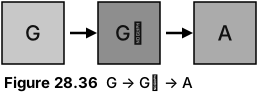
and:
C→C♯→D.
H. Three cadences
Practice:
Dm9 → G13 → C6/9
Dm9 → D♭13 → C6/9
Fm9 → B♭13 → C6/9
Compare their colors.
I. Familiar-tune transformation
Take a familiar melody originally played straight.
Do not reharmonize it at first.
Give it a bossa accompaniment.
Then make only minimal melodic-rhythm adjustments.
Record both versions.
J. Complete bossa arrangement
Create a 2–4 minute arrangement containing:
- short intro
- steady LH bass pattern
- syncopated RH harmony
- melody clearly above
- one anticipated chord
- one secondary dominant
- one chromatic inner line
- sparse fill
- deliberate ending
Keep the dynamics restrained.
The challenge is not complexity.
It is independence and rhythmic precision.