Workshop 64 — Pentatonic Superimposition: One Five-Note Shape, Many Harmonic Meanings, Modern “Outside” Color, and Improvising Without Sounding Like a Scale Exercise
Workshop 63 compressed seven-note scales into two familiar triads.
Now we compress harmony in another extremely practical way:
What if one familiar five-note pentatonic shape can become several completely different harmonic vocabularies simply by changing the bass underneath it?
You already know the ordinary use of pentatonics:
C major pentatonic:
C D E G A
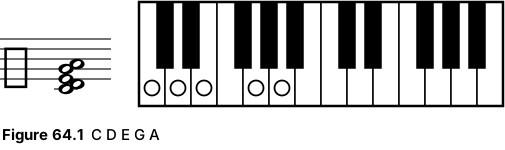
and C minor pentatonic:
C E♭ F G B♭
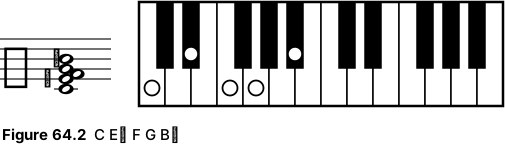
Today we stop thinking of them merely as “easy scales.”
Instead, a pentatonic becomes an upper structure.
The central lesson is:
The pentatonic shape may stay identical while the bass determines whether it sounds tonic, suspended, Lydian, altered, dominant, modal, or outside.
64.1Begin with C major pentatonicC D E G A64.2Why pentatonic sounds so openNotice what is missing from C major scale:64.3Level 1 — C major pentatonic over CLH:64.4Now change only the bassKeep RH pitch collection exactly:64.5Analyze over DC = ♭7 D = root E = 9 G = 11 A = 5.64.6First major principleThe name:64.7Level 2 — C major pentatonic over FBass:64.8This is extremely usefulInstead of thinking:64.9Level 3 — C major pentatonic over ABass:64.10Play the bass sequenceRH never changes pitch collection:64.11Fixed vocabulary, changing harmonyThis gives us another version of Workshop 50:64.12Level 4 — omit the pentatonic rootOver F bass, deliberately avoid C.64.13Treat the scale as a reservoirUse:64.14Pentatonic sequencingTake three-note cell:64.15Why pentatonic lines sound less scalarThe interval pattern includes:64.16Pentatonic #2 — C minor pentatonicC E♭ F G B♭64.17C minor pentatonic over A♭Bass:64.18Play itLH:64.19Level 5 — C minor pentatonic over FFunctions:64.20Over B♭C minor pentatonic over B♭ gives:64.21A very useful practical ruleMajor/minor pentatonics are not merely associated with their named roots.64.22Level 6 — major pentatonic a whole step above a major tonicTake D major pentatonic:64.23Compare Workshop 63Previously:64.24Level 7 — C Lydian without playing CLH:64.25Three-note cellsFrom D major pentatonic:64.26This solves a common improvisation problemIf someone says:64.27Level 8 — same pentatonic over another bassKeep D major pentatonic:64.28Move bass to ED major pentatonic over E:64.29Pentatonic #3 — minor pentatonic a minor third above a dominantNow we enter altered-dominant territory.64.30This is a spectacular shortcutFor G7alt:64.31Compare with Workshop 63We used:64.32Level 9 — resolve every altered noteG7 shell:64.33Again, destination firstDo not say:64.34Level 10 — altered phraseOver G7alt:64.35Pentatonic #4 — minor pentatonic from the ♭3 over dominantThis is closely related.64.36Level 11 — ordinary versus altered dominantG7→Cm.64.37Pentatonic #5 — major pentatonic from ♭7 over suspended dominantTake:64.38This is almost absurdly easyWant a C9sus melodic vocabulary?64.39Level 12 — sus→dominant via one noteUse B♭ major pentatonic over C.64.40PracticeC bass.64.41Pentatonic superimposition and “avoid notes”This system gives a better way to think about so-called avoid notes.64.42That reduces mental policingRather than:64.43Level 13 — pentatonic over pedal harmonyC pedal.64.44This is an extraordinary composition exerciseOne bass note.64.45Level 14 — switch only one pitch collection per sectionFour bars:64.46Level 15 — common-tone transitionsBetween C major pentatonic:64.47Between C major and C minor pentatonicC major: C D E G A.64.48Level 16 — chromatic pentatonic side-slipWorkshop 62 returns.64.49Why it works so wellA pentatonic has a distinctive internal shape.64.50Practice side-slip safelyCm9 vamp.64.51Level 17 — rhythmic side-slipKeep the same three-note motif.64.52Level 18 — two pentatonics as call-responseOver C pedal:64.53AnotherCall: C minor pentatonic.64.54Level 19 — pentatonic pairsJust as we used triad pairs, you can alternate two pentatonic collections.64.55Level 20 — pentatonic sequencing in fourthsC major pentatonic contains:64.56Level 21 — stack fragments as voicingsTake D major pentatonic over C.64.57Another voicingC bass.64.58Pentatonic clustersBecause pentatonics avoid certain semitone clashes, you can often cluster several neighboring members.64.59Level 22 — melody harmonization from a pentatonicSuppose melody note:64.60Melody note EStill in D major pentatonic.64.61Level 23 — pentatonic chord melodiesTake a simple melody in C.64.62Don't change collection every melody noteThat becomes harmonically twitchy.64.63Level 24 — modal vamp with pentatonic escalationCm vamp.64.64Level 25 — one pentatonic, changing octaveDo not change notes.64.65Level 26 — pentatonic rhythmic permutationsUse notes:64.66Five-note cycle against 4/4One note per eighth.64.67Do not confuse two independent ideasPitch sequence length: 5 notes.64.68Level 27 — one pentatonic over walking changesThis is harder.64.69Example conceptC major pentatonic across:64.70This is horizontal thinkingVertical thinking:64.71Level 28 — dominant exceptionWhen strong G7→C arrives:64.72PlayC area: C major pentatonic.64.73Level 29 — simplify on resolutionDuring G7alt:64.74Level 30 — pentatonic blues ambiguityOver C7:64.75Mix major and minor pentatonicOver C blues:64.76Level 31 — major phrase, minor answerOver C7:64.77Don't combine them into one eight-note soupKeep phrase identity.64.78Level 32 — pentatonic economy testChoose one five-note set.64.79Level 33 — two-note fragments onlyFrom D major pentatonic over C:64.80Level 34 — chord punches from pentatonic subsetsOver C Lydian:64.81Level 35 — combine with quartal harmonyTake pentatonic notes and form fourth-like shapes.64.82This is an important conceptual convergenceWe are no longer learning isolated tricks.64.83Practice Loop A — one pentatonic, four bassesRH:64.84Practice Loop B — Lydian shortcutC bass.64.85Practice Loop C — altered shortcutG bass + B/F shell.64.86Practice Loop D — suspended dominantC bass.64.87Practice Loop E — major/minor bluesC7.64.88Practice Loop F — side-slipCm vamp.64.89Practice Loop G — pentatonic voicingsTake D major pentatonic.64.90Ear Drill — same pentatonic, new bassC major pentatonic phrase.64.91Ear Drill — C major versus D major pentatonic over CC major pentatonic contains:64.92Ear Drill — ordinary G7 versus pentatonic alteredPlay G7→Cm plainly.64.93Ear Drill — sus identityC bass.64.94Mini-composition exerciseWrite 32 bars centered around C.64.95Apply it to “Happy Birthday”Use C major.64.96Apply it to “Mack the Knife”During classic swing choruses:64.97Apply it to “The Bare Necessities”For the funk/fusion version:64.98The deeper improvisational lessonBeginners often ask:64.99A practical hierarchyWhen improvising over a difficult chord, you do not have to think from largest to smallest.64.100What we're really learningAdvanced improvisation increasingly means:•Workshop 64 mini-test1. Why are pentatonics particularly useful for superimposition?