Homework for Module 29
A. Motion types
At the keyboard create examples of:
- contrary
- similar
- parallel
- oblique
using only two voices.
Say the motion type aloud.
B. Melody + bass only
Take one familiar melody.
Play it with a bass line but no full chords.
Make the bass melodic rather than just roots.
C. Contrary motion
Use:
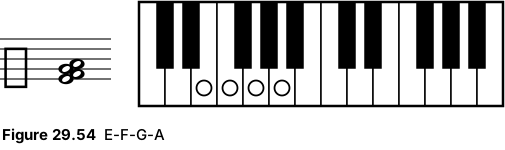
RH: E-F-G-A
LH: C-B-A-G
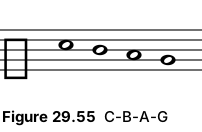
Then create three variations.
D. Oblique motion
Hold RH G.
Move LH through:
C-B-A-G-F
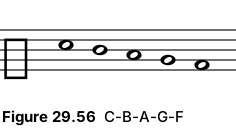
Then harmonize each bass note minimally.
Listen to G's changing function.
E. Chromatic inner lines
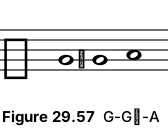
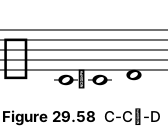
Build progressions around:
G-G♯-A
C-C♯-D
A-A♭-G
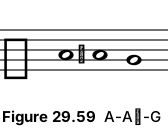
Keep the chromatic note in an inner voice, not the melody.
F. ii–V–I voices
Over:
Dm7-G7-Cmaj7
play:
Bass: D-G-C.
Inner line 1: F-F-E.
Inner line 2: C-B-B.
Add a simple top melody.
G. Counter-melody
Take a melody with long notes.
Write a 3–5 note counter-line that enters only when the melody sustains.
Keep it quieter.
H. Left-hand melody
Play a simple tune in LH.
RH accompanies.
Make LH unmistakably louder.
This is both counterpoint and voicing practice.
I. Imitation
Create a 3-note RH motif.
Have LH imitate it one bar later at a different pitch.
Do not worry about sophisticated harmony.
J. Full exercise
Arrange 8 bars with:
- clear melody
- melodic bass
- one inner counter-line
- one contrary-motion passage
- one suspension
- one moment of imitation
- at least one section where the texture becomes simple again
Record it.