Module 22 mini-test
1. What is chord substitution?
2. Why can D♭7 substitute for G7 when resolving to C?
3. What are the guide tones of G7?
4. What are the guide tones of D♭7?
5. What is the tritone substitute for D7?
6. What is the tritone-substituted ii–V–I in C?
7. What is a backdoor dominant into C?
8. What is the backdoor ii–V into C?
9. Why can common-tone substitutions work even when roots are remote?
10. Does “substitute” mean two chords sound identical?
Answers
- Replacing a chord with another that can preserve enough of its function, voice leading, or melody relationship to work in the same location.
- They contain the same dominant guide-tone tritone enharmonically.
- B and F
- F and C♭, with C♭ sounding as B.
- A♭7
- Dm7 → D♭7 → Cmaj7
- B♭7 → C
- Fm7 → B♭7 → C
- Shared melody/inner notes plus smooth semitone voice leading can create strong continuity despite unrelated roots.
- No. It means they can perform sufficiently similar harmonic work while producing different color.
The central idea of Module 22 is:
A chord's root is not the only thing that determines what it can do. Its guide tones, melody relationship, and voice leading can be even more important.
And now a progression that once looked impossible:
Dm7 → D♭7 → Cmaj7
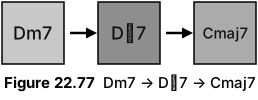
should make sense: the bass moves D → D♭ → C, while the essential dominant voices still resolve B → C and F → E.
Module 23 will be much more pianistic: intros, fills, turnarounds, transitions, and endings—how to start a song without simply counting in, what to play when the melody leaves space, and how to finish with something more intentional than just hitting the tonic chord.