466 / 18210 · Module 12 — Secondary Dominants: How to Make Chords Pull Toward Other Chords← prev⊞ allnext →
12.8The accidental tells you where the harmony is going
This becomes a powerful reading skill.
Suppose you're in C major and suddenly see:
C♯
Maybe you're approaching D.
For example:
A7 → Dm
C♯ wants:
C♯ → D
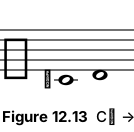
Suppose you see G♯:
likely:
E7 → Am
G♯ wants:
A
Suppose you see F♯:
possibly:
D7 → G
F♯ wants:
G
So when a chromatic accidental appears, ask:
What note is this trying to resolve to?
That often reveals the secondary dominant immediately.